
From manual to fully automatic: the evolution of massage product automation

Massage has been an important component of health and well-being for millennia. From early manual techniques to highly intelligent and automated massage devices, the evolution of massage products closely follows the development of technology, reflecting the global shift in demand for massage services. This article describes the global development path of massage products from manual control to automation, following the timeline of development.
The era of manual control: reliance on human skills and auxiliary tools
Before the advent of modern massage devices, manual control was the only form of massage. Early massage relied entirely on human hands, using techniques such as kneading and tapping to relieve muscle tension. At that time, massage therapists, through their experience and skill, provided relaxation services. In the early 20th century, basic tools such as wooden massage sticks and foam rollers were introduced to aid this process. While these tools increased the effectiveness of the massage to some extent, they still required manual control from the user.

Manual massage techniques were not simply a matter of repeating movements; they required therapists to have a great deal of knowledge and skill. They had to accurately identify acupuncture points and apply specific pressure techniques to balance the body's energy, a concept that originated in traditional Chinese medicine (TCM). For example, techniques such as Japanese shiatsu and Chinese tuina focus on stimulating acupuncture points and balancing the flow of energy in the body.

The process of manual massage went beyond physical therapy; it was a holistic form of mind-body healing. While providing physical relief, therapists also interacted with patients to understand their health and mental state, offering more personalized treatment plans.
However, due to the high dependence on the therapist's experience, professional massage services became a luxury that only a select few could afford.
Early electrification: the transition from manual to mechanical mode
In the mid-20th century, electrification began to play a significant role in the development of the massage industry. With the development of technology, people's needs for massage changed, focusing not only on comfort and relaxation, but also on efficiency and convenience. During this period, products such as massage chairs and portable electric massagers were introduced to meet these changing needs. (As a large-scale massage equipment, massage chairs mainly massage the whole body, while portable electric massagers focus on massaging local parts of the body to meet people's different needs.) The combination of mechanization and electrification shifted massage from manual control to more automated, efficient methods.
Massage chairs, originally invented in Japan, became popular from the 1950s to the 1980s. These early models mainly used mechanical arms to mimic the movements of human hands. For example, the mechanical arms could mimic actions such as kneading and pressing to relax the user's muscles. However, early massage chairs had significant limitations: they were mostly static and were used primarily in the home, which meant they lacked the dynamic, motion-based features that modern, high-end massage chairs offer today.
By the 1990s, portable electric massagers had become more common. Their advantage was their flexibility, allowing users to target specific areas, such as the shoulders, neck, or legs, for localized relief. Unlike full-body massage chairs, users could now conveniently use portable massagers without having to massage their entire body or be confined to a specific area.

Electric massage devices were intended to replace manual effort with mechanical movements to improve efficiency. However, these devices lacked advanced intelligence, which meant they were often set to operate on fixed patterns, unable to adapt to the varying needs of individual users. For example, users might require different intensities, speeds, or targeted areas for massage, but early electric devices struggled to cope with these varying demands.
The revolution of intelligent technologies: the introduction of artificial intelligence and automation
Despite the effectiveness that electric massage devices provided, users began to demand more personalized and precise massage. This is when smart technologies began to show their potential. The use of artificial intelligence (AI) and sensor technologies allowed massage devices to move from simple mechanical movements to a more human-centered, intelligent experience. This shift marked the beginning of a new era of smart massage products. Notable examples of this era are fascia guns and smart massage chairs, which highlighted the impact of AI technology on various user groups and applications.
Fascia guns emerged in the fitness community in Europe and North America in the 2010s as a solution to the problem of muscle soreness and tension after exercise. These devices delivered high-frequency percussion to help relieve muscle tension. Compact and portable, fascia guns allowed users to target specific muscle groups, making them a must-have for many fitness enthusiasts and professional athletes.

However, fascia guns still required manual control. Users needed to apply force and precision to provide an effective deep tissue massage. Prolonged use can cause hand fatigue, especially when treating large muscle groups such as the back or thighs. Improper use, such as using excessive force or impacting sensitive areas such as joints or the neck, can lead to discomfort or injury.
During the 2010s and 2020s, technological advances allowed more intelligent features to be integrated into massage chairs. Some models included artificial intelligence. sensors that scanned the user's body to personalize the massage. For example, when the user sat in the chair, the sensors determined their height, weight, and body shape, and then adjusted the massage program accordingly. This provided a more personalized experience, ensuring the right pressure and coverage for different body types.

A distinctive feature of smart products was their ability to interact with users, adjusting the intensity and areas of massage based on real-time feedback. While this improved the user experience, massage chairs remained bulky and their adaptability to different environments was limited. Despite the advances, portability and flexibility continued to be a challenge.
Full automation and portability: meeting diverse needs
To meet the diverse needs of massage in different settings, the massage industry is increasingly adopting full automation. A new wave of massage products, such as fully automatic roller massagers, offers a more advanced portable solution.
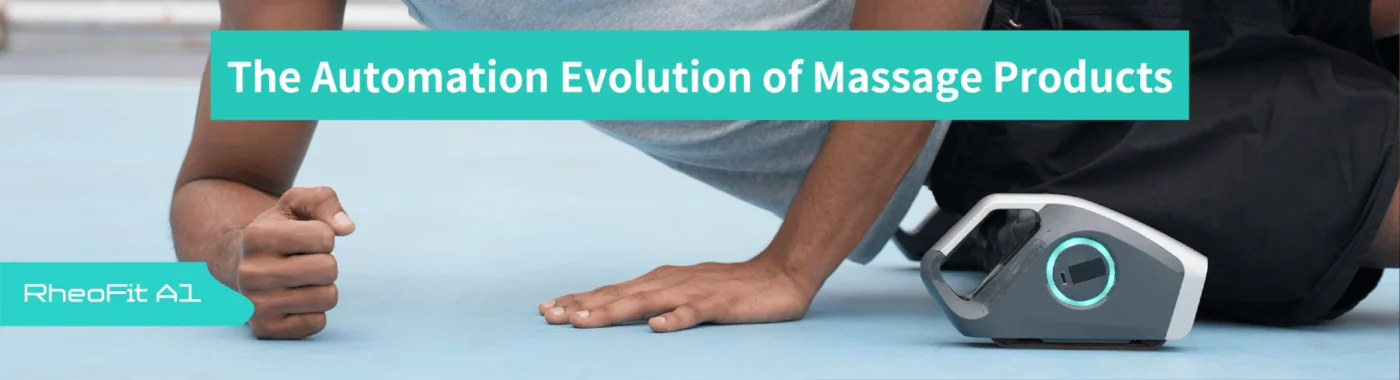
The fully automatic roller massager scans the entire body using the user’s weight and then delivers a personalized massage based on the scan, without any manual intervention. This innovation allows users to enjoy a flawless massage without having to adjust settings or manually operate the device. RheoFit has pioneered this category with its groundbreaking product – the RheoFit A1, the world’s first fully automatic roller massager.


Additionally, the RheoFit A1 offers interchangeable ergonomic 3D massage cushions, allowing users to choose between soft and firm massage cushions based on personal preference. These cushions are designed to relax deep muscles, fascia, and lymphatic tissue while avoiding bony structures to provide maximum comfort and effectiveness.

Compared to previous manual and electric devices, the RheoFit A1 offers deep, comprehensive relaxation that adapts to the user's body structure and recovery needs. Combining advanced technology with a user-centered design, the RheoFit A1 provides a fully automated massage that is tailored to each individual. In addition, its portable design makes it ideal for use at home or in the gym.

Conclusion
The evolution of massage products towards full automation is a major milestone in the industry, reflecting the shift from manual use to highly intelligent and efficient solutions. The emergence of products such as the RheoFit A1 marks a new era of massage, offering a fully automatic, personalized experience that integrates artificial intelligence technology and body scanning. These advances significantly increase user convenience, allowing for an easy and effective massage tailored to individual needs.
Meanwhile, products like the RheoFit A1 break the limitations of traditional bulky massage equipment. Its portability ensures that it can be used in a variety of settings, including homes and gyms, satisfying the need for high-quality massage anytime, anywhere.
From manual techniques to electrification, intelligent innovations, and now full automation and portability, the evolution of massage products reflects technological progress and the growing demand for personalized solutions. As technology advances, massage products will become even more precise and effective, meeting the personalized needs of a wide range of users and becoming an integral part of health management in the future.